Wednesday, April 04, 2007

“MIND” and MEMORIES: When Nature’s “Assets” Become Warped into “Liabilities,” Part Fourteen

Table of Contents

Today's Considerations
Recent Posts and Archives
Tools for Realization
Author's eBooks
Author's Paperback Books
Free eBooks
[Continued from yesterday]

F.: The “mind” has been shown to be the source of all assumed personality. Personality, in turn, has been shown to be the source of most of the relative existence problems on the planet, and each of the nine basic types generates a particular set of personality disorders. Before looking at the personality disorders that each of the basic types generates, a point should be offered that comes from the American Psychiatric Association’s Diagnostic and Statistical Manual of Mental Disorders, 4th edition, 1994 (commonly referred to as “DSM-IV”):

A personality disorder is a pattern of deviant or abnormal behavior that the person doesn't change even though it causes emotional upsets and trouble with other people at work and in personal relationships. It is not limited to episodes of mental illness, and it is not caused by drug or alcohol use, head injury, or illness.

So, all of the (relative) negatives of personality, negatives which have motivated Advaitin sages for centuries to encourage the abandonment of personality, are becoming better understood. What additional motivation to Realize could possibly be required among those with any wisdom at all, once the facts about personality are understood: (1) to identify with the personality, formed as a childhood exercise, is a disorder; (2) the behavior that follows the assumption of personality is deviant and abnormal; (3) it is persons--not the Realized--who cling to false personas as identities; (4) emotional intoxication is rooted in personality; (5) relative existence problems, whether at work or at home or in between are rooted in personality; (6) personality has nothing to do with mental illnesses; and (7) personality problems are not caused by addiction, physical injury, or mental illness.
As a relevant example of the DSM-IV definition, apply it to the billions who are suffering from the Addictive Personality Disorder (APD). Take drug or alcohol abuse as an example. Per definition, the disorder is “not caused by drug or alcohol use.” The drug or alcohol abuse is a symptom of a personality disorder. Neither the drug nor the alcohol is the core problem; therefore, if an alcoholic suffering from APD merely stops drinking, that will have no effect at all on removing the negative traits and behaviors of the personality disorder. The traits and behaviors will continue as a result of what the primary literature calls the “grave mental and emotional disorders” that APD’s exhibit. (Also, note that the literature did not say that APD’s have “grave mental and emotional illnesses,” though some do. Most are suffering personality disorders, not mental illness. That applies to all APD’s, no matter whether they are addicted to food, power, gambling, shopping, another person, alcohol, religion, drugs, sex, love, spirituality, chaos, money, etc.)

As noted earlier, the reason that persons with disorders typically do not change is because consequences are not imposed or because they are not imposed to a degree that inspires taking the necessary action to be free of the effects of one or more personality disorders. (That is another reason that few will ever seek Realization and why fewer still will ever Realize fully.)

Further, any rationalizations and justifications and denial and excuse-making in regards to those with personality disorders—such as “His/her behavior must be understood or tolerated as a result of mental illness” or “She/he is an alcoholic or drug addict and that must be considered” or “He/she has some injury or illness”—are (as shown by the definition above) totally unfounded, inapplicable, and irrelevant in regards to personality disorders. Tolerance of the warped thinking and warped behavior of persons with such disorders only prolongs their entrapment in personality and guarantees the continued manifestation of the effects of their disorders.

Now, pause to reconsider the information quoted above from the DSM-IV. Then, list all of the roles that you have assumed that are inspiring you to feel anxious or to fight. Are there certain self-images that are you trying to defend? Is there any evidence that you are forfeiting the fullness and freedom of AS IF living in order to maintain some assumed personality/persona? Are you having trouble in a relationship because “The Boss” persona is fighting for control? Are you angry with someone who is not supporting your false image? Please enter the silence of contemplation. [To be continued]

NOTE: This series includes excerpts from the book

THERE’S NO SUCH THING AS “PEACE OF MIND”
(There is Only Peace if You’re Out of Your Mind)
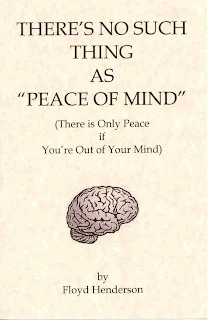

to be released around May 1st for $14.99 + S&H.

Do you know someone who could benefit from reading a book about the hazards of the modern mind and the impact that personality has on the relative existence? Do you want your own copy of the book that covers the content of these postings and more?

SAVE $4.95


A special offer is available to site visitors who pre-order now: for those who pre-order and pre-pay, FREE shipping and handling will be provided, first class, when the book arrives. That translates to a $4.95 saving off of our standard PRIORITY shipping method. You may visit

http://floydhenderson.com/order.htm

and provide all of your mailing and billing information and then in the "Special Message" box, note that you are pre-ordering “There’s No Such Thing.”
SPECIFICATIONS: Paperback; Language: English; Binding: Spiral Binding

For more information on the book, visit http://advaitavedantabooks.blogspot.com/

Tuesday, April 03, 2007

“MIND” and MEMORIES: When Nature’s “Assets” Become Warped into “Liabilities,” Part Thirteen

Table of Contents

Today's Considerations
Recent Posts and Archives
Tools for Realization
Author's eBooks
Author's Paperback Books
Free eBooks
The very worst of each personality type in evidenced when persons are stressed, overly pious, or making money off their phony role-playing. How many on the planet are not either stressed, overly-pious, or receiving income for playing their roles? The negatives are prevalent—relatively speaking—and dominate the “human (persona) experience.”
[Continued from yesterday]

F.: Often, Type Sevens as children were trying to cope with a rigid or emotionally-unavailable or demanding parent (more often the mother). Sevens sense, rightly or wrongly, that the inflexible parent is never totally pleased with them or that the parent is never willing to fully accept their uniqueness. (That is generally a result of the fact that the mothers of many Sevens were either facing their own challenges at the time the Seven was a child; or had an attachment disorder; or were over-stressed because of circumstances but lacked the coping skills to deal effectively with those circumstances; or were preoccupied with their own agenda and interests.) Sevens as children become dedicated to trying to lighten the mood of the overly-serious parent. As a result, Seven’s end up on a life-long quest to have fun and escape restrictions (such as those imposed by a rule-loving parent). Later, however, they also become hesitant to make commitments in their own adult relations, preferring to keep many options open instead.

Often, Type Eights as children were trying to cope with a mother in a battle for control. Typically, the Eights succeeded in getting their way as a child and they expect to always get their way throughout their adult years as well. They usually become domineering and controlling and often want both earthly and “heavenly” power in order to have all of the power necessary in order to try to control everything and everyone.

Often, Type Nines as children were dealing with excessively supportive or indulgent parents, so as adults they have a sense of entitlement that makes work unattractive and creates an expectation that others should take care of them. Nines can become quite lazy and can use passive-aggressive methods to manipulate others to care for them.

(NOTE: It has been asked in the past, “If childhood and family conditions have such an influence on determining personality type, why do siblings so often have different personality types?” The answer is, “Because no two brothers or sisters are raised by the ‘same’ parents or in the ‘same’ family.” Meaning? Meaning that parents are in a state of flux and families are in a state of flux. The dynamics are never the same for any two children, though they might be members of the 'same' family, since economic cycles rise and fall, since the parents’ relationship ebbs and wans, and since the addition of each child affects the character of the family unit.)

Thus, the most common personality defects (as revealed above) which mar the relative existence include the following: self-absorption; judgmentalism; giving, but only in order to receive even more in return; viciousness; being overly-competitive; being phony; being aloof; being unavailable; being morbid; being fear-based and insecure; being blindly loyal; being an escapist; being a control freak; being demanding; and being lazy. Those are the typical products of the basic personality types. Add the defects that appear when persons adopt another twenty or thirty ego-states ("spouse," "employee," "lover," "homeowner," etc.) and the fallout from personality becomes overwhelming, throwing the entire planet into chaos. Some have asked: “What about those who are ‘healthy’ and behave ‘well’”? The answer is simple:

The very worst of each personality type in evidenced when persons are stressed, overly pious, or making money off their phony role-playing. How many on the planet are not either stressed, overly-pious, or receiving income for playing their roles? The negatives are prevalent—relatively speaking—and dominate the “human (persona) experience.”

The more significant Advaita pointer is this: when strategies (a) originated in the mind of a child who was trying to cope with abnormal circumstances and when those strategies (b) produced a specific personality and when (c) those childhood strategies are still driving abnormal and subconscious behavior years later, then those are strategies that actually should play no part at all in the relative-existence lives of adults. For freedom to happen, the warped “mind” that generated personality during childhood must be dissolved and the personality (and its persona-driven behaviors) must be discarded.

Next, there are two or three specific personality disorders that are common to each of the basic personality types, so those will be discussed. In the meanwhile, are you seeing any of those examples of personality in your own conduct? Do you see any evidence of those remnants of a child within often controlling your thoughts and behaviors? Are you seeing why Advaitin sages recommend being free of body-mind-personality identification?

Are you seeing why Advaitins make the point that the problems of the relative existence are rooted in personality and that, in order to be free of chaos, all personal attributes and personal identifications must be discarded? For more on that, click
  • here
  • Please enter the silence of contemplation. [To be continued]

    Monday, April 02, 2007

    “MIND” and MEMORIES: When Nature’s “Assets” Become Warped into “Liabilities,” Part Twelve

    Table of Contents

    Today's Considerations
    Recent Posts and Archives
    Tools for Realization
    Author's eBooks
    Author's Paperback Books
    Free eBooks
    The very worst of each personality type in evidenced when persons are stressed, overly pious, or making money off their phony role-playing. How many on the planet are not either stressed, overly-pious, or receiving income for playing their roles? The negatives of personality—relatively speaking—are prevalent and dominate the “human (persona) experience.”

    [Continued from yesterday]

    F.: If one walks into a forest and becomes lost, the surest way out is to retrace one’s steps, exactly, in reverse order. Similarly, the “path” to Realization is the exact opposite, step-by-step, of the way one became lost in body-mind-personality identification. This series is showing how the contamination process happened in order to see what must occur for the re-purification of the consciousness to happen. Only if one sees, “Oh, my gosh, yes, that applies to me” might one realize why the “journey” is indicated as the appropriate “treatment” for what ails the earth’s human population.

    Therefore, the earlier points that “persona-playing will lead persons to personality disorders” and that "adults behave in childish ways" should now be understood. What remains to be understood is what those “bizarre circumstances” are that drive children to develop a specific personality and to behave in the ways that are unique to that personality type.
    Each of the nine personality types identified by the enneagram, therefore, developed certain traits and behaviors in childhood that “worked” to some degree in those early, unhealthy parent-child relations but that become major obstacles when applied to adult-aged relations (which are most typically marred with the playing of “The Child role” or “The Parent role” in the absence of “Adult”-appropriate conduct). Here are the abnormal home conditions that generate personality and that set children on a destructive course as they apply their childhood strategies to adult-age circumstances (meaning, as they unconsciously allow personality to dictate the ways that they think, emote, and behave):

    Often, Type Ones as children were trying to cope with a rigid, judgmental environment in which parents set forth unreasonably excessive moral and ethical demands and expectations, especially involving religious restrictions. Ones become reformers or perfectionists, can become highly self-critical if they don’t adhere as adults to the parental expectations that were set forth during childhood, can become judgmental, and will often label others as being “bad” or “evil.”

    Often, Type Twos as children were trying to cope with an environment in which parents were emotionally unavailable, were offering only a conditional version of love, or wherein a parent (often the father) was in absentia, physically or otherwise. They can spend their entire adulthood is a search for love and will give away far too much in the quest.

    Often, Type Threes as children were reacting to an especially indulgent parent (often to the mother). Sometimes, an abusive male parent was present, and the hiding of family secrets set the stage for manufacturing the images that were shown outside the home (which were quite different from the abusive reality that existed inside the home). The stage was set for creating and maintaining positive images while living darker lives behind closed doors. Threes, therefore, can experience a sense of incongruity since their "positive" outside image never ...
    This is an excerpt from the book
    THERE’S NO SUCH THING AS “PEACE OF MIND”
    (There Is Only Peace if You’re Out of Your Mind)


    For information on the book, visit http://advaitavedantabooks.blogspot.com/

    To order the book, visit
    http://floydhenderson.com/order.htm
    (You can use the Special Message box)
    Please enter the silence of contemplation. [To be continued]

    Sunday, April 01, 2007

    “MIND” and MEMORIES: When Nature’s “Assets” Become Warped into “Liabilities,” Part Eleven

    Table of Contents

    Today's Considerations
    Recent Posts and Archives
    Tools for Realization
    Author's eBooks
    Author's Paperback Books
    Free eBooks
    Eventually, persona-playing will always lead persons to personality disorders, to believing that their images are real, and to believing that they know why they do what they do and believing they know who they are when, in fact, they do not have the slightest clue.

    [Continued from yesterday]

    F.: Part of the solution to being free of the influence of personality is to understand why personality develops and to see how truly bizarre and perverted are its roots. Why did Maharaj teach that the relative problems of adulthood are rooted in the distortions of childhood? Genetic and body chemistry factors aside, personality develops primarily as children attempt to develop a strategy for coping with the circumstances that they face in their families of origin, circumstances that have become increasingly bizarre as the centuries have passed.

    Those behavioral patterns developed during childhood (patterns which came about as a result of bizarre circumstances) then drive persons throughout the rest of their childhood and their adulthood as well, a fact which guarantees the continued cycling of lunacy and nonsense. Bizarre circumstances produce a bizarre personality which generates even more bizarre behavior and circumstances during adulthood. Subsequently, those adults will bear children and then another generation will face bizarre circumstances as a result of bizarre-thinking adults and the bizarre programming and conditioning and enculturation that they pass along. Such environments force another generation of children to develop defective personalities in an effort to cope with the defective circumstances presented by adults who are driven by defective minds and defective thoughts and defective personalities.

    To understand that adults are being driven by the subconscious strategies of a child within makes clear why so much childish nonsense is being generated among adults. It explains why adults will childishly follow a leader as he guides them into the depths of hell-on-earth; it explains why adults will childishly and unquestioningly believe ...
    This is an excerpt from the book
    THERE’S NO SUCH THING AS “PEACE OF MIND”
    (There Is Only Peace if You’re Out of Your Mind)

    For information on the book,
    visit http://advaitavedantabooks.blogspot.com/

    To order the book, visit
    http://floydhenderson.com/order.htm
    (You can use the Special Message box)
    Please enter the silence of contemplation. [To be continued]

    Recent Posts and Archives